
Introduction: The “Tuesday Morning Drag”
Your critical project did not miss the deadline because of talent shortages. It missed the deadline because your Senior Manager spent Tuesday morning navigating a complex compliance exception in SharePoint instead of unblocking the team.
This is the “Execution Drag.”
Despite record investments in Employee Experience (EX) platforms, managers are currently trapped in a losing economic model. We bought tools to empower employees. But often, these platforms simply route more administrative tasks, approvals, and notifications to the manager. We digitized the bureaucracy instead of removing it.
In other words, each new portal and workflow digitized the paperwork but still routed the work to the same node, the manager.
As the company grows, we historically treat manager support as a variable cost. We add HR capacity to handle the surge in tickets, policy questions, and reviews. We assume that complexity requires more bodies.
This assumption is breaking the enterprise.
According to Bloomberg’s 2024 analysis, the median HR-to-employee ratio has reached an all-time high of 1.4 per 100.
Yet, managers remain overwhelmed.
This paradox exists because HR professionals are typically locked in support silos where they handle complex compliance and payroll tickets. They are not sitting in the flow of work. When an employee has a question at 2 PM, they do not open a ticket. They message their manager.
Even with a record number of HR staff, the manager remains the “first line of defense” for every policy question and blocker. Caught between aggressive delivery targets and this administrative overload, they often spend less than a third of their time actually leading.
The problem is not that managers have too much to do. It is that they are doing the wrong kind of work.
We need to stop assuming the only way to handle organizational complexity is to add more HR staff. We need to deploy intelligent systems that absorb the noise. This requires a fundamental shift. We must move from “Manager Support as Labor” to “Manager Support as Infrastructure”.
In this context, infrastructure means a reusable network of AI agents that sits across your systems and absorbs administrative noise before it reaches managers.
Key Takeaways for Leaders
- For the CHRO: A network of agents closes the “support gap” by providing 24/7 support and guidance to every manager. This stabilizes engagement and reduces the risk of burnout-driven turnover.
- For the COO: By removing administrative friction, agents accelerate decision velocity and execution. Managers stop fighting systems and start unblocking teams.
- For the CFO: AI Agents shift manager support from a variable cost (headcount) to a fixed infrastructure cost. This delivers a scalable efficiency dividend.
What are AI Manager Agents?
AI Manager Agents are a network of specialized AI assistants that plug into your existing HR and collaboration systems. They share context with each other and handle repeatable manager work like policy questions, recognition, feedback prompts, and coaching nudges so human leaders can focus on judgment and relationships.
State of the Manager 2026: The “Squeezed Middle”
Before we discuss the solution, we must audit the problem. The “middle manager” has become the most fragile point in the organizational structure.
- The Stress Epidemic: McKinsey reports that middle managers are the “squeezed middle,” with 43% experiencing burnout. They absorb pressure from above (strategy) and below (execution) without the tools to cope.
- The Performance Gap: Gallup’s State of the Global Workplace warns that managers account for 70% of the variance in their team’s engagement. If the manager is distracted, the team’s output stalls.
- The Skill Void: Gartner’s 2025 Priorities Report reveals a stunning disconnect. While 75% of organizations updated their leadership programs this year, the majority admit they are “not seeing results.” Furthermore, 74% of HR leaders state that their managers are still not equipped to lead change. The traditional classroom model has failed.
The financial implication is clear. We are paying our most expensive people to do work that burns them out. This slows down the entire business in the process.
Traditional fixes like more training, more portals, and more policies add effort but not capacity. This is why an always-on agent network changes the economics.
To actually change the economics, you need a different kind of support layer. That layer is a network of AI Manager Agents.
Agents vs. Chatbots: Why the Distinction Matters
To solve this, we must distinguish between “Chatbots” and “Agents.” This is a vital distinction for IT, Operations, and HR leaders.
- Chatbots are reactive. You have to stop working, find the bot, and ask a question.
- Agents are proactive. They live in the flow of work and come to you.
An AI Manager Agent is a specialized, always-on intelligent partner integrated into your daily tools. Unlike a standard chatbot that passively answers FAQs, a Manager Agent observes context (calendar events, team sentiment, performance data) and proactively nudges leaders to take specific, high-value actions.
Meet Your Manager Agents: Your New Operations Squad
At Semos.ai, these agents do not live in isolation. They act like a specialized Virtual HR Squad surrounding each manager. This is not a single generic chatbot. It is a coordinated team of specialized agents that share context and hand work off between them.
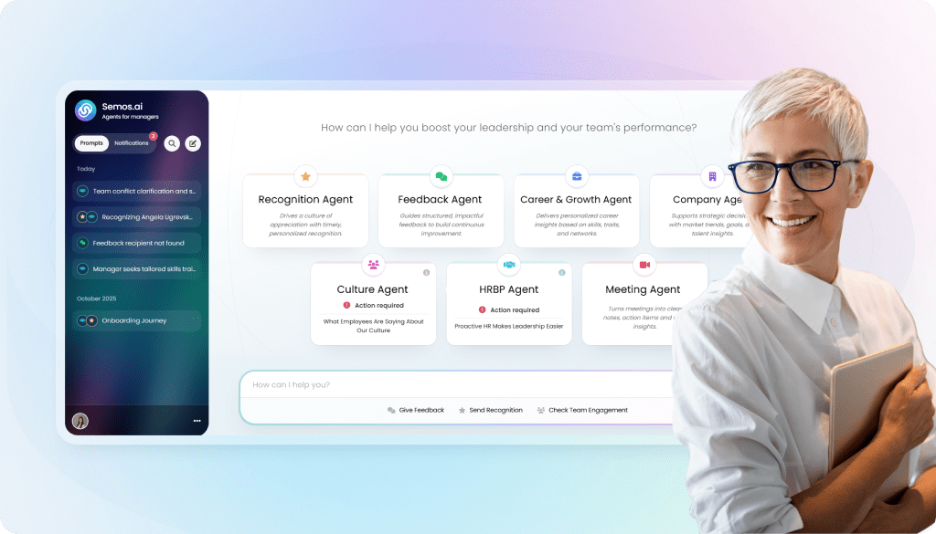
- The Meeting Agent: Your executive assistant. It summarizes calls and captures key decisions so you do not have to replay the recording.
- The Recognition Agent: Your culture driver. It identifies meaningful employee contributions and helps you craft recognition messages that reflect your company’s core values and behavioral expectations.
- The Feedback Agent: Your leadership coach. It reviews your draft performance feedback and suggests improvements to ensure your message lands correctly.
- The Company Agent: Your business intelligence unit. It connects managers with relevant market trends, competitor moves, and organizational goals so they can align their team’s execution with the bigger picture.
- The Culture Agent: Your team sensor. It monitors communication patterns and participation. If it senses a drop in inclusivity, it prompts you with specific team-building actions.
- The HRBP Agent: Your policy expert. It answers complex questions about leave, benefits, and compliance in seconds, keeping you out of the HR ticket queue.
- The Career & Growth Agent: Your development radar. It spots emerging strengths and suggests concrete growth moves so you do not have to leave development to chance.
These agents coordinate around the manager. The Meeting Agent knows what the Feedback Agent recommended. The HRBP Agent understands what the Culture Agent is seeing. This pattern holds whether you lead a branch, a sales team, a product squad, or a support function.
The Evolution of Enterprise Tech
To understand where this fits in your stack (SAP, Workday, Oracle), visualize three layers:
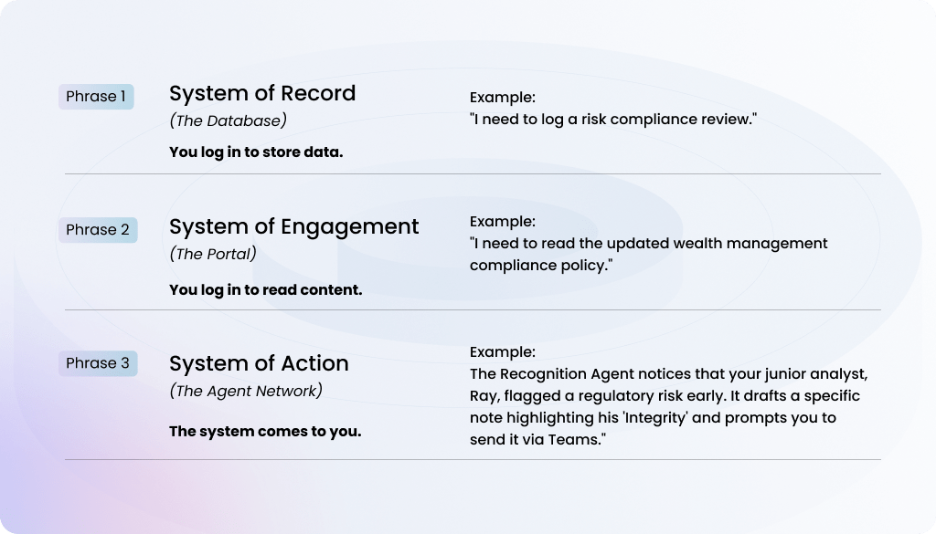
- Phase 1: System of Record (The Database). You log in to store data.
- Example: “I need to log a risk compliance review.”
- Phase 2: System of Engagement (The Portal). You log in to read content.
- Example: “I need to read the updated wealth management compliance policy.”
- Phase 3: System of Action (The Agent Network). The system comes to you.
- Example: “The Recognition Agent notices that your junior analyst, Ray, flagged a regulatory risk early. It drafts a specific note highlighting his ‘Integrity’ and prompts you to send it via Teams.”
A System of Action does not wait for people to log in. It detects what is happening and routes the right action to the right manager at the right time.
The 3 Levers of Operational Economics
When we deploy this agent network, we materially change the cost structure of management. In practice, it means you do not need to keep hiring one more HR generalist every time a region adds 500 people. Here is how the math works across three specific ROI pillars.
1. Reducing the Cost of Inefficiency (The Admin Tax)
Ask any branch or team manager to walk you through their Tuesday. You will find the same pattern: 10 minutes with a customer rep and 40 minutes buried in HR portals searching for policy clarifications.
How Semos.ai changes the math:
Imagine an HRBP Agent that instantly answers complex policy questions.
- Manager Time: For most common questions, the HRBP Agent gives managers an answer in seconds without waiting in a ticket queue.
- Setup Speed: In most pilots, these agents connect to Slack, Teams, and Outlook in under 10 minutes without opening an IT ticket, while larger rollouts follow the usual security and change processes.
- The ROI Scenario: If 50 bank managers each save just 2 hours per week on administrative searching and drafting tasks, that recovers 5,000 hours/year. That is the equivalent of 2.5 FTEs of leadership time unlocked that can go back into coaching teams, fixing customer issues, and driving growth.
2. The Productivity Multiplier (Engagement)
In banking, employee engagement directly affects customer experience, sales conversion, and compliance. Yet, cultural consistency across thousands of locations remains elusive.
How Semos.ai changes the math:
Our agents act as “training wheels” for leadership behaviors.
- Cross-Agent Orchestration: A weekly risk review finishes in the Wealth division. The Meeting Agent analyzes the minutes and notices that a junior analyst (Ray) flagged a potential regulatory risk early. This led to a policy adjustment.
- The Prompt: The Recognition Agent uses that context to nudge the manager: “Ray identified a compliance gap that prevented exposure. Would you like to recognize his proactive risk management?”
- The Result: Recognition messages are auto-aligned to core values like Trust and Integrity. This reinforces behaviors that protect the brand.
- The Data: In live pilots, managers using this infrastructure captured 3x more recognition, feedback, and coaching moments per week compared to those without.
3. Scaled Impact: Democratizing Leadership
Traditional leadership coaching is typically reserved for the top 10% of executives due to high costs. AI Manager Agents democratize this support by providing 24/7 leadership support to every frontline supervisor.
How Semos.ai changes the math:
You move from Variable Cost Scaling to Fixed Cost Scaling.
- Variable (Old): To coach 500 more managers, you need 50 new coaches.
- Fixed (New): To coach 500 more managers, you simply assign 500 more licenses.
The Culture Agent and Career & Growth Agent act as sensors, highlighting risk so the human manager knows exactly where to coach. This ensures that a frontline shift supervisor in a remote location gets the same quality of support as a VP at headquarters.
Built on Science, Not Just Syntax
Experienced leaders might ask, “Is this just ChatGPT wrapping generic advice?”
No. Semos.ai agents are grounded in proven behavioral methodologies to ensure every “nudge” actually drives performance.
- The Feedback Agent is built on Stanford’s 4Is Framework (Information, Impact, Invitation, Implication). This ensures difficult conversations are structured and constructive, not just critical.
- The Career & Growth Agent utilizes the Big Five Personality Model to tailor development suggestions to a specific employee’s traits. It moves beyond generic “climb the ladder” advice.
- The Recognition Agent leverages Behavioral Reinforcement Theory to identify the precise moments when praise will have the highest impact on retention.
If you want to dive deeper into the models we use, you can read our full methodology here.
Quick Diagnostic: Sizing the Opportunity
If you want to estimate the financial impact for your organization, check these three numbers:
- The Admin Drag: Estimate avg. manager hours spent on scheduling/policy search per week (e.g., 3 hours).
- The Attrition Cost: Calculate the replacement cost of one voluntary exit (1.5x Salary).
- The Efficiency Gain: Model the savings if you claw back just 2 hours/week per manager via Agentic AI.
Why “Nudges” Failed (And Why Agents Work)
If you ran a “nudging” program five years ago, you might ask: “We tried this. Why is this different?”
The difference is Context vs. Noise.
Old-school nudges were generic notifications. They pinged every manager at 9:00 AM on Monday saying, “Remember to give feedback!” This created “notification fatigue” because it ignored the manager’s reality.
Agentic AI is context-aware.
- It sees that you just finished a client implementation (Context).
- It sees that team sentiment is slightly down (Data).
- It proposes a specific action: “Celebrate the implementation success to boost morale” (Action).
This is why modern strategy emphasizes moving toward “Boundaryless HR” (as described in Deloitte’s 2024 Global Human Capital Trends). Technology must integrate seamlessly into the flow of work rather than acting as a separate, annoying task.
Conclusion: Liberating Human Potential
The argument for AI Manager Agents is financial, but the outcome is deeply human.
We are not automating management. We are automating the noise that prevents management from happening.
By using Semos.ai to handle the scheduling, the policy lookups that clog managers’ calendars, and the routine nudges, we liberate your human leaders to do what only they can do. They can build trust, show empathy, and inspire their teams.
The economics are the entry point. The stakes are human. If your managers are already underwater, the question is not whether you can afford AI Manager Agents. It is how long you can afford the drag without them.
Ready to evolve your leadership model?
Join the Early Access Program for Semos.ai Manager Agents and see how quickly your managers can reclaim their time.
Chatbots answer questions in isolation. Semos.ai’s Manager Agents share context, so your coaching, feedback, and recognition do not live in separate workflows. That is why managers feel like they have a small operations team in their inbox, not a single FAQ bot.
No. They handle the always-on, repeatable part of support so HRBPs and coaches can focus on the 10–20% of situations where judgment, politics, and context really matter (org design, complex performance issues, restructuring, etc.).
ROI is driven by three factors: reduced administrative time for managers (Efficiency), lower voluntary turnover costs (Retention), and increased team productivity through consistent feedback (Performance).
Yes. As part of the Semos Cloud platform, Semos.ai inherits deep integrations with major HCM platforms like SAP SuccessFactors, Workday, and Oracle. It acts as the “System of Action” layer that utilizes the data stored in your “System of Record”.